
Proofline_1.svg
INNOVATION

Argonne Breakthrough in Spintronics Unlocks Atomic-Level Magnetism for Future AI Chips

7,996 reads 5 comments
Argonne Breakthrough in Spintronics Unlocks Atomic-Level Magnetism for Future AI Chips

Scientists at Argonne National Laboratory have taken a major step toward redefining the future of computing by uncovering how magnetism behaves at the atomic scale. Their research centers on Spintronics, an emerging technology that uses the spin of electrons rather than their electrical charge to process and store information. By studying ultrathin magnetic materials known as van der Waals magnets, the team has revealed how tiny magnetic regions form and evolve, opening the door to faster, smaller, and more energy-efficient devices.

This breakthrough comes at a critical time, as traditional silicon-based electronics struggle to keep up with the demands of artificial intelligence and data-heavy applications. Spintronics offers a path forward by encoding information in magnetic states at extremely small scales, dramatically reducing energy consumption. The Argonne team demonstrated that subtle changes in material thickness can significantly influence how these magnetic domains behave, providing engineers with new ways to precisely control data at the nanoscale.

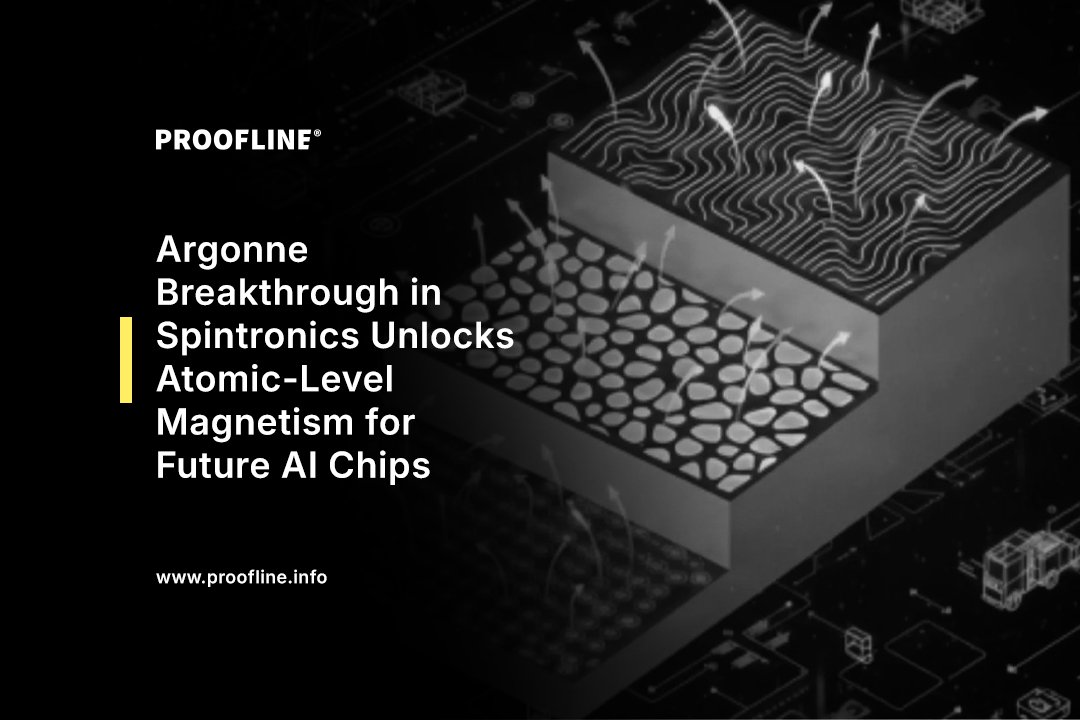
To explore these effects, researchers focused on Fe₃GeTe₂, a promising two-dimensional ferromagnetic material. By cooling it to extremely low temperatures and applying magnetic fields, they were able to create and manipulate distinct magnetic patterns. Using advanced imaging techniques at the Center for Nanoscale Materials, the team observed how electron spins organize in real time, offering unprecedented insight into the inner workings of these materials.

One of the most significant findings involves skyrmions, tiny and stable magnetic structures formed by swirling electron spins. These structures require very little energy to move, making them ideal for next-generation memory and processing technologies. By understanding how to control their size and density, researchers can begin designing ultra-dense storage systems and low-power processors that go far beyond today’s hardware capabilities.

Summary

Argonne National Laboratory’s research into spintronics and atomic-scale magnetism marks a major advance in next-generation computing. By revealing how magnetic domains and skyrmions behave in ultrathin materials, scientists are paving the way for faster, more efficient, and highly scalable electronics suited for the growing demands of AI and data-intensive technologies.

Comments (5)

Zander

Spintronics could change computing efficiency drastically, less energy but more power ⚡

Kairo

Using electron spin instead of charge is a huge leap beyond traditional chips 💻

Brent

This might be the answer to AI’s growing energy consumption problem 📊

Leif

Controlling magnetic domains at nanoscale is seriously impressive 🔬

Omarion

Future processors could be faster and cooler with this tech 🔥

Leave a Comment

Comments are reviewed before publishing.

0/300